
Liquid Human Skin 1068
Contact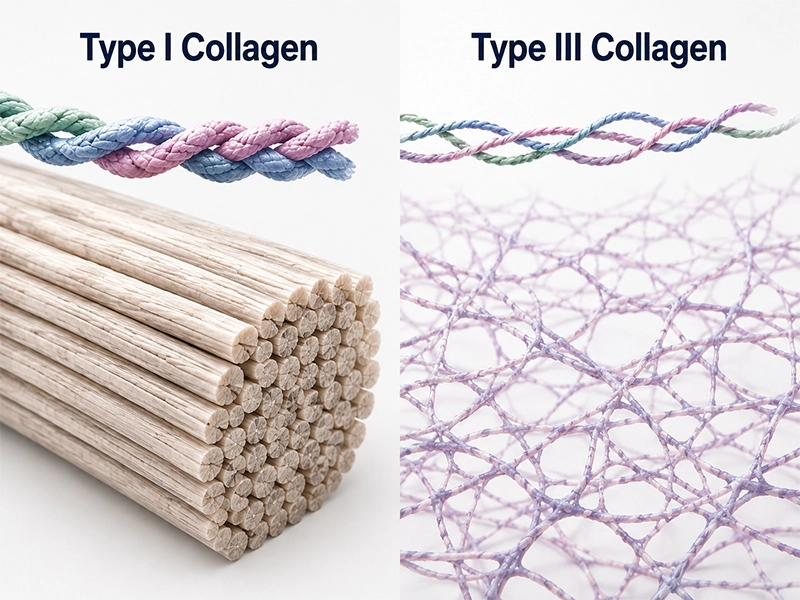
Differences Between Collagen Types
>TYPE I AND TYPE III COLLAGEN
Type I Collagen — The Primary Structural Collagen in Skin
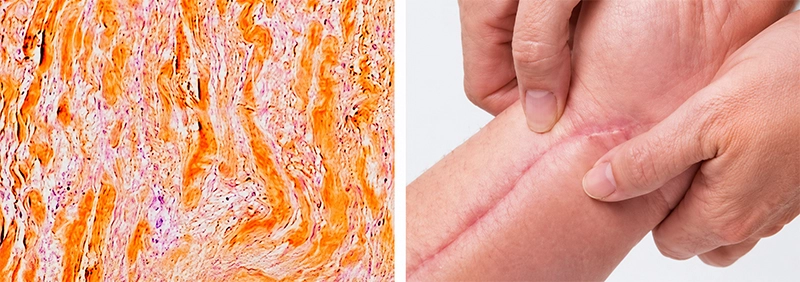
Type I collagen accounts for approximately 80–85% of the collagen found in the dermis. It forms thick, tightly packed fibers that provide the skin with structural strength, firmness, and mechanical support.
Type I collagen also plays an important role in maintaining tissue integrity and supporting the skin’s natural repair process.
However, excessive or abnormal accumulation of Type I collagen during tissue repair may contribute to fibrosis and visible scar formation.
Type III Collagen — Supporting Skin Elasticity and Regeneration
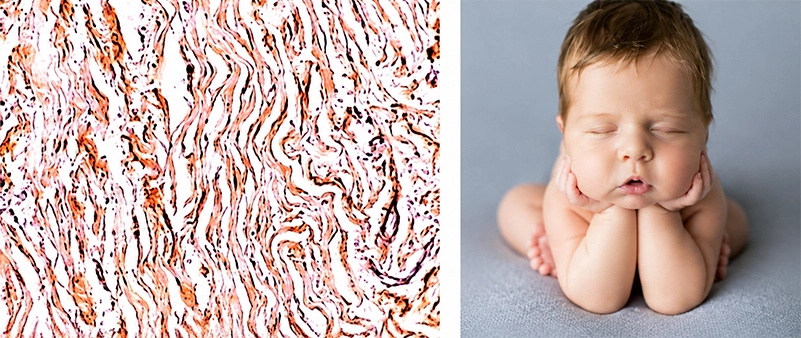
Type III collagen forms a fine, loosely organized network within the skin. It is present at relatively high levels in infant skin and accounts for approximately 15–20% of collagen in adult skin.
It plays an important role in maintaining skin elasticity, softness, and tissue repair, while helping support the skin’s natural regenerative process.
Higher levels of Type III collagen are generally associated with finer, more flexible skin structure and may contribute to more balanced tissue remodeling with a lower tendency toward visible scar formation.
>THE DIFFERENCE BETWEEN ANIMAL SOURCES AND RECOMBINANT SOURCES
The Evolution of Collagen Production
Collagen has a long history of use and can be obtained from a variety of sources. Traditionally, one of the primary methods of obtaining collagen was extraction from animal tissues.
With continued advances in biotechnology, recombinant DNA technology and fermentation-based production have emerged as advanced approaches to collagen manufacturing, offering a more controlled and consistent alternative to traditional animal-derived collagen.
| Source | Animal-Derived Collagen | Recombinant Collagen |
| Production Method | Extracted from animal tissues using chemical and enzymatic methods | Produced through genetic engineering and fermentation |
| Potential Viral Risk | Present | None |
| Allergic Reaction Risk | Present | Very Low |
| Water Solubility | Insoluble in Water | Readily Soluble in Water |
| pH | 3.0–4.5 | 6.5–7.5 |
| Denaturation Temperature | 37–43°C | >72°C |
| Tissue Compatibility | Relatively Low | High |
| Advantages | Widely available sources; suitable for large-scale production | Highly homologous to human collagen;
high bioactivity; suitable for large-scale production |
| Disadvantages | Lower bioactivity; potential risks of viral contamination
and cytotoxicity |
Higher Production Cost |
>THE DIFFERENCE BETWEEN LONG COLLAGEN AND SHORT COLLAGEN
| Type | Liquid Human Skin 1068 | Short Peptides |
| Structure | Intact collagen peptide chains with a high molecular weight | Cleaved or degraded peptide fragments with a low
molecular weight |
| Application | Medical-Grade Collagen (Medical Device Grade) | Non-Medical Use (Cosmetic Grade) |
| Advantages | Provides structural support and retains comprehensive biological
activity |
Good permeability and easier transdermal absorption |
| Limitations | Limited transdermal absorption due to its larger molecular size | Incomplete functional domains |
| Primary Function | Mainly forms a protective barrier on the skin surface, helping reduce
transepidermal water loss (TEWL) and protect the skin from external contaminants such as bacteria, viruses, and dust |
Mainly provides skin-conditioning and nourishing
benefits, supporting the skin’snatural renewal process |
| Did You Know? High-Molecular-Weight Collagen Still Plays an Important Role in Skin Care
High-molecular-weight collagen does not need to penetrate deeply into intact skin to provide meaningful skincare benefits. When the skin barrier is compromised, collagen can interact more closely with the affected surface and help create a supportive environment for the skin’s natural recovery process. For daily skincare, high-molecular-weight collagen can form a moisture-retaining protective film on the skin surface, helping reduce moisture loss, protect against external stressors, and support a healthier skin barrier. Through hydration and surface conditioning, it helps leave the skin feeling softer, smoother, and more resilient. |